The October lasagna dinner was the setting for Kathy O’Brien, Invertebrate Specialist with the Endangered Species Unit of the NYS Department of Environmental Conservation, to tell us about the current status of our favorite butterfly.
O’Brien began by describing the butterfly. Karners are tiny, about the size of a quarter. The females are brownish, while the males are very blue. Perhaps the most endearing quality of the Karner is that it is not unusual for the Karner to land on hands of observers.
Karner Blues are often confused with Eastern Tail Blues, which look similar and are much more common. Karner Blues have orange spots on the underside of the lower wing arranged in a crescent shape. Eastern Tail Blues have two or three orange spots.
Ants tend the larvae of the Karner Blue, fending off wasps from the larvae, and in return the ants receive a sugar-water excretion from the Karner Blue caterpillar.
Karner Blues only eat the wild blue lupine. Lupines are in the pea family and are a long-lived perennial. Their roots go down about six feet. Lupines like the sun and open areas, and do not like fertile soil. The lupines have a relationship with a nitrogen-fixing bacteria. Thus, with this bacteria, the lupines are able to fix their own nitrogen, giving the lupine an advantage over plants that cannot fix nitrogen.
The former range of the Karner Blue was all of New York. As late as the 1970s, specimens were found in Rome and Tanowanda.
The Karner Blue is lost now from Ohio, New Hampshire, and Ontario, Canada. The Karner Blue has declined because of development, the taking of habitat and the lack of wildfires to create new habitat.
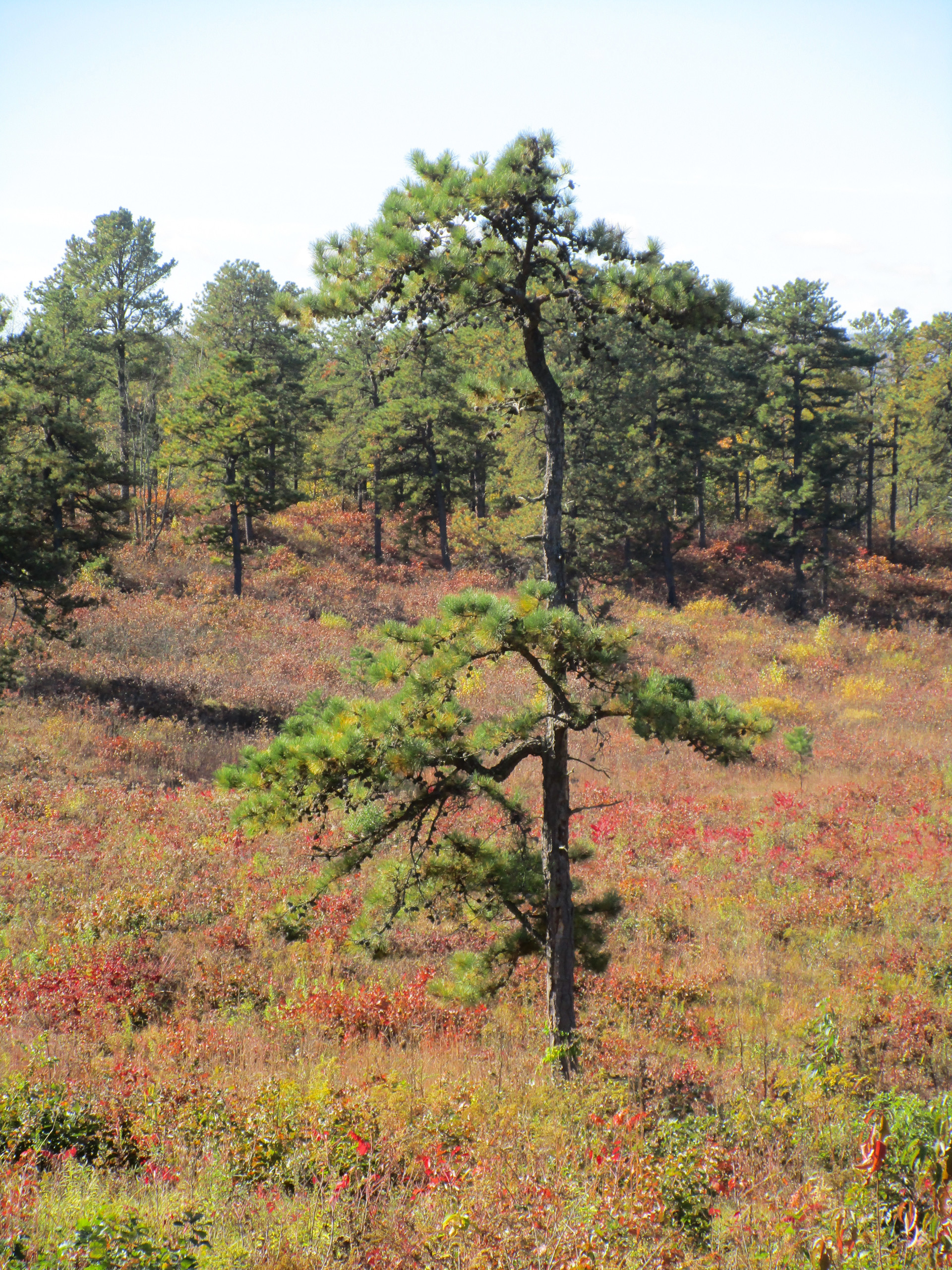
Karner Blues are now only found in "lifeboats" — areas that are accidentally suitable for blue lupine.
The largest site of Karner Blues in New York is now at the Saratoga Airport, which supports perhaps 10,000 individuals. It is orders of magnitude larger than other Karner Blue sites in New York.
The Karner Blue is listed on both the State and Federal endangered species list. Currently, the U.S. Fish and Wildlife Service is developing a recovery plan for the Karner Blue. The plan identifies the problems with the species, what is being done currently to help the species, what needs to be done to ensure a viable population and defines recovery units.
A viable population for Karner Blues is at least 3,000 individuals. Not only do Karner Blue benefit from having their habitat restored, but other insects and animals that share the same ecosystem benefit, such as the Frosted Elfin and Persius Dusky Wing butterflies, the spadefoot toad, and the hognose snake. There are lots of animals in trouble, not just the Karner Blue.
The Karner Blue population in New York is in deep trouble. Populations have been in decline since the 1970s. In 1998, weather events took a tremendous toll on the Karner Blues in New York. That year, the tornado that hit Stillwater happened during the peak period of the butterflies. Because many butterflies did not reproduce due to the bad weather, that set up a smaller number of butterflies for the next year. The Karner Blue population did very poorly in 1999 and 2000. When a population is so small, such as in the Pine Bush, it doesn’t take much to destroy it.
Printed in the December 2001, January 2002 Newsletter